
Entrepreneurship & ecosystem
Denver's Startup Ecosystem: Capital, Talent, and Where to Build
Jeff Schell and Majid Boroujerdi debate Denver's startup ecosystem: raising capital, recruiting experienced talent, and choosing Colorado as a home base.
To evaluate Denver's startup ecosystem, separate two questions: where can your company find capital, and where can it find the people needed to grow? They do not necessarily have the same geographic answer. A Colorado headquarters can work with a national investor network, while a critical hire may depend on very specific local experience.
That distinction drives a disagreement in the debut episode of Mile High Makers. Jeff Schell argues that founders should look beyond Colorado for funding without giving up Colorado as their home base. Majid Boroujerdi pushes on a different constraint: experienced people need more than a reason to move here. They need confidence that a career, and a family, can stay here if one job ends.
Their exchange offers a useful way to think about building a business in Denver: identify the connections your company needs, rather than assuming one city must supply everything. This article develops that argument from our host-to-host conversation, recorded August 14, 2026. The published episode went live on YouTube on August 20.
Key takeaways
- A Colorado home base and a national fundraising network can coexist. Jeff's advice is not a call to relocate the company.
- Majid distinguishes attracting people to Colorado from offering experienced hires a durable local career path.
- Evaluate the talent, investors, and operating resources relevant to your business, not just the city's reputation.
- Turn Colorado relationships into specific introductions, hiring conversations, and help with the next business problem.
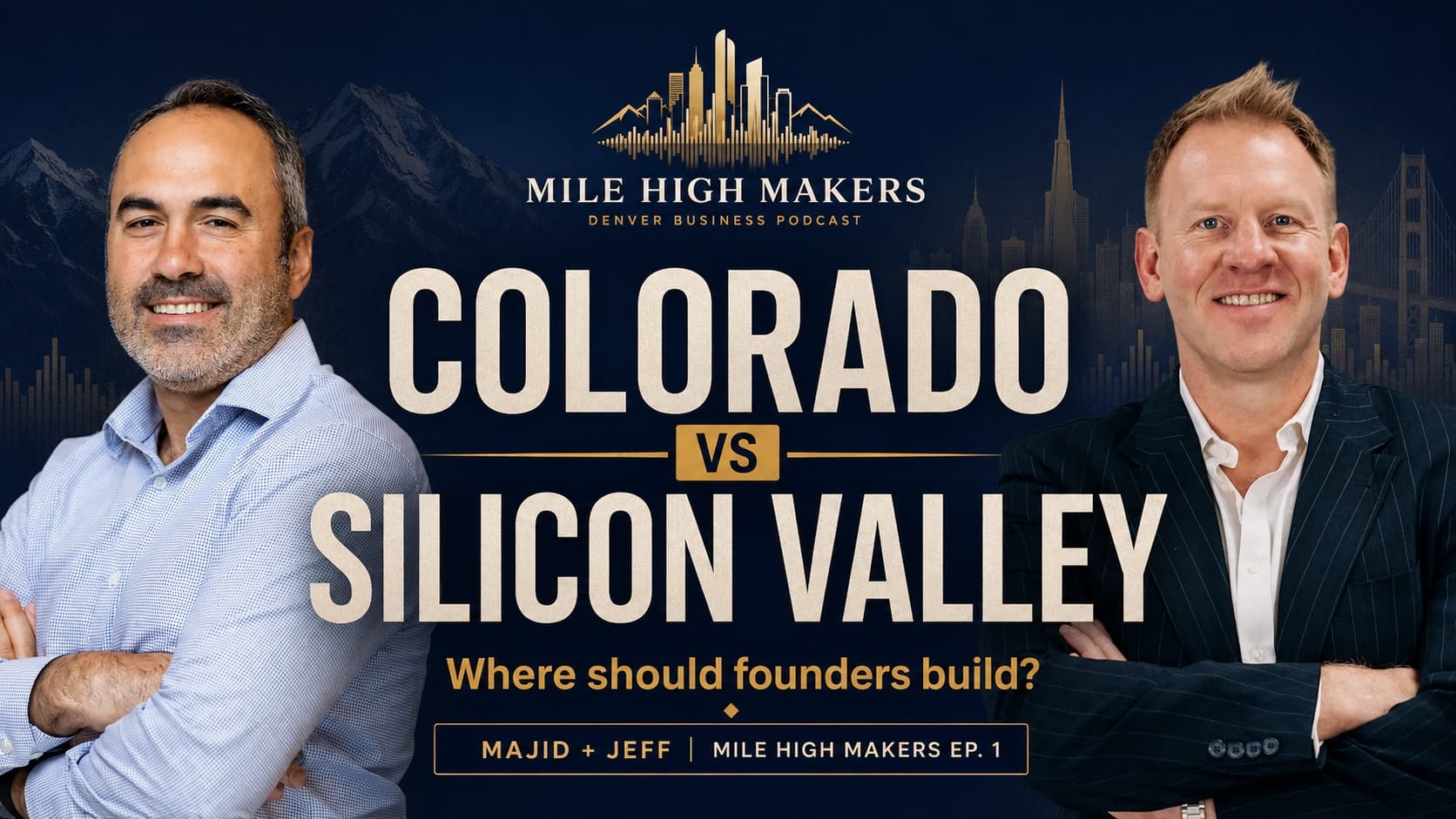
Two builders, different views of the bottleneck
Jeff brings a patent attorney's and entrepreneur's perspective; his Whiteford biography also documents venture-capital experience. Majid draws on engineering, brand, and innovation work, including roles at Procter & Gamble and The Hershey Company. This is an editorial analysis of their conversation, not a guest-authored article. Meet the hosts and learn why we started Mile High Makers.
What Colorado offers founders, beyond a lifestyle pitch
Majid describes Denver as a place where openness and a willingness to help remind him of his hometown in Louisiana. He values its geography for travel, its outdoor access, and the ability to enjoy city life without giving up the mountains. These are his reasons for choosing Colorado, not a claim that every founder will find the same fit.
The hosts also connect time outside work with sustaining the effort of building a business. Jeff pairs that enthusiasm with a caveat: an attractive place to live does not supply the internal drive to build. Quality of life can support the work; it does not replace customers, capable colleagues, or a viable business.
For founders, the useful test is concrete. Which relationships become easier to maintain from Denver? Does the location work for the customers and partners you visit? What will help your team sustain its effort? Those answers are more useful than treating Colorado's appeal as a complete business case.
Denver startup funding does not have to stop at the state line
Jeff's fundraising argument separates the company's address from its sources of capital. He is not telling founders to abandon Colorado investors. He is warning against making Colorado the entire fundraising strategy. When Majid asks whether a founder can still keep Denver as a home base, Jeff says yes.
His emphasis is on building relationships outside the state, including spending time with people in person. That is a different proposition from moving the team to wherever an investor happens to be. It also puts responsibility on the founder to create those connections, rather than waiting for the local network to deliver every introduction.
An application of that advice is to build an investor list around business fit: sector, stage, relevant experience, and the kind of support needed. Then ask which relationships can start locally and which require a broader search. Budget time and travel deliberately. Neither a Denver introduction nor an out-of-state meeting is a guarantee of funding.
The conversation is a perspective on fundraising geography, not a measurement of Colorado venture capital or a comparison of current funding totals. Its practical value is the permission to build locally without restricting the business to local resources.
The Denver startup ecosystem debate: capital or talent?
Majid pushes back on the idea that access to money is the whole constraint. A company also needs people who know how to do the next job. He points to experienced marketing and technology talent as examples where the available pool can be thin in particular categories.
Jeff is more optimistic about Colorado's ability to attract people. Majid's response is not that people dislike Colorado. It is that wanting to live here and being prepared to relocate a family are different decisions. If the first role disappears, what comes next?
That is the unresolved tension worth preserving. Jeff sees the location as a recruiting advantage. Majid wants a deeper set of employment opportunities before treating that advantage as enough. Neither observation establishes a statewide talent surplus or shortage; the answer depends on the role and the industry.
For a founder, test the question at the level of actual hiring needs. A strong general network is not the same as a ready pool of executives who have scaled your type of company. Identify the next few essential roles and speak with people who understand those hiring markets before promising that recruiting will be easy.
Experienced operators need a career path, not just one offer
Majid's family-relocation argument shifts the recruiting conversation from the first job to the durability of a career. Multiple plausible employers matter because an experienced hire is evaluating more than the startup's current enthusiasm.
Jeff raises remote work as a possible answer to that concern. Majid is less persuaded that it resolves the problem. The episode does not settle how employers will organize work; it highlights why a recruiter should not assume a remote fallback is available to every candidate.
The lesson for a hiring team is to have the fuller conversation. Discuss the actual work arrangement, the candidate's professional network, and the family's location priorities. Be honest about what is established and what is still a bet. Colorado's lifestyle can be part of the offer without being asked to answer every concern.
Choose the relevant industry network, not a Silicon Valley replica
Jeff does not want Colorado's ambition reduced to copying Silicon Valley. The hosts point to aerospace, quantum computing, and food and consumer products as areas worth discussing. Those examples suggest a better question than whether Denver resembles another city: where does this particular business find useful experience and relationships?
A founder evaluating Denver, Boulder, or the wider Colorado startup ecosystem should make that question specific. Who understands the product? Who has hired the people you need? Which potential partners can help with the next operating problem? A sector's prominence alone does not answer those questions for an individual company.
Raj Babu's later interview provides a concrete consumer-brand example. He distinguishes Colorado's strengths in getting food brands started from the resources needed to scale them. Our article on scaling a food business in Colorado without outgrowing its cash explores those operating decisions. It is a narrower application of the same principle: use the home base, then fill the actual gaps.
A stronger downtown community needs repeated contact
Jeff imagines downtown Denver bringing entrepreneurs, investors, and developers into closer contact. The useful part of that idea is not a prediction about office prices. It is the possibility of making introductions, collaboration, and informal learning easier to repeat.
His concern about lost startup momentum should not be read as evidence that Startup Week disappeared. As context checked after the August recording, the organizers' Colorado Startup Week website says the event adopted its statewide name in 2025 and lists September 14-18 for its 2026 schedule.
For a founder, the opportunity is to turn a gathering into an ongoing relationship: make a specific request, offer relevant help, and follow up. A useful business community is built between events as well as at them. That is a more actionable response to concerns about momentum than waiting for the city to recover a past reputation.
Five questions before choosing Colorado as your home base
These questions are our editorial synthesis of the debate, not a checklist the hosts presented:
- Where does the right capital live? Identify relevant investors without making the state boundary the filter.
- Which hires determine the next stage? Evaluate experience in your category, not just general interest in moving to Denver.
- What would make a relocation sustainable? Discuss career options and work arrangements alongside the role itself.
- Which Colorado connections will you use? Name the people, industry groups, or operating partners relevant to a real business need.
- How will you stay connected beyond Colorado? Make outside relationships part of the operating plan, not an emergency response.
Mile High Makers exists to keep this kind of conversation going. The debut does not produce a verdict that Colorado is right for every founder, or agreement about its biggest constraint. It asks what the people building Colorado can do next. Watch the full conversation below, explore the other interviews, and subscribe for more perspectives on Colorado's business future.
From the conversation
Watch Episode 1 with Majid and Jeff
The full published debut brings the two hosts together to discuss Colorado's startup community, capital, talent, and the reasons behind Mile High Makers. Published on YouTube August 20, 2026.
Colorado vs. Silicon Valley: Where Should Founders Build?
Majid and Jeff open the series with a conversation about where founders should build.
Keep exploring Colorado business
- Building Fussbally in Colorado
Lasse Lobmeyr offers a local service founder's different perspective on talent, relationships, and growth.
- Scaling a food business in Colorado without outgrowing your cash
Raj Babu's operating perspective on a specific Colorado growth challenge.
- Why Colorado Is the Epicenter of Better-For-You Food
Watch the full conversation with Raj Babu of BFG Partners.
- Meet the hosts behind Mile High Makers
The experience and purpose behind our Colorado business conversations.